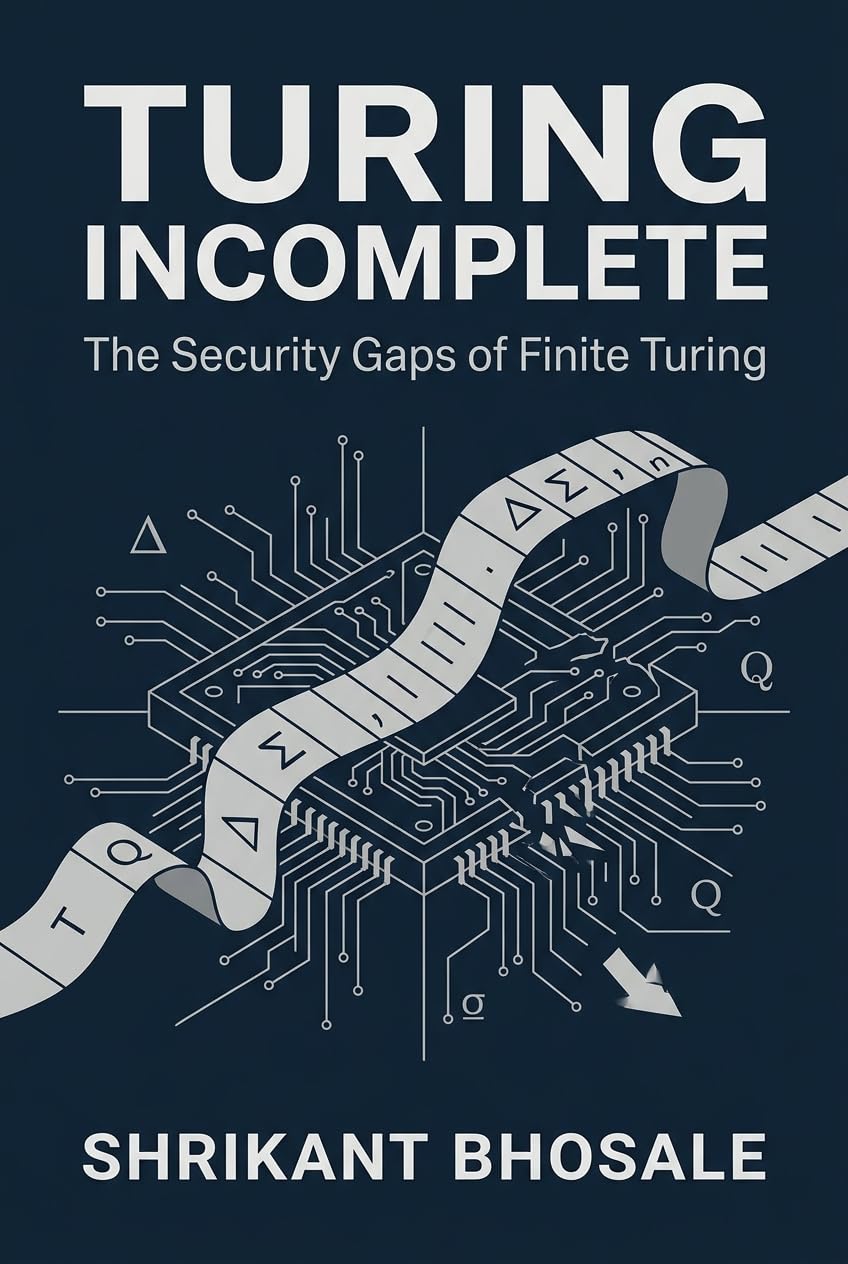
Turing Incomplete
The Security Gaps of Finite Turing

“Why classical Turing machine assumptions are the silent root cause of modern cybersecurity collapse.”
Executive Synopsis & The Silicon Discrepancy
All of modern computer science rests upon an elegant mathematical fiction: the infinite Turing tape. When Alan Turing formalized the universal machine in 1936, he explicitly assumed infinite time, boundless memory tapes, and cost-free state transitions unconstrained by thermodynamic laws.
However, no infinite tape has ever been fabricated in a semiconductor foundry. In the physical universe, all computing machines are finite state automata operating in finite spacetime, bound to finite silicon gates, governed by voltage propagation delays, and constrained by thermal dissipation.
In Turing Incomplete, Shrikant Bhosale exposes how the theoretical chasm between mathematical infinite Turing models and physical finite silicon hardware constitutes the subterranean root cause of the modern security crisis. Side-channel leakage, speculative branch execution exploits (Spectre, Meltdown), cache timing differentials, and fault injection attacks are not bugs—they are physical reminders that reality is not Turing complete.
Demonstrating how mathematical proofs of computability fail when mapped onto bounded physical substrates.
Why speculative execution and hardware optimizations violate the formal abstract state machines of compilers.
Connecting Landauer’s principle, entropy dissipation, and electromagnetic emissions directly to cryptographic collapse.
A novel paradigm for provably secure computing based on geometrically closed state spaces rather than unconstrained tape models.
Treatise Modules & Curated Chapters
-
PART I
The Myth of the Infinite Tape: 1936 to Modern Silicon
The mathematical genesis of computability. How Alan Turing’s abstraction solved the Entscheidungsproblem while inadvertently blinding three generations of systems designers to physical constraints.
-
PART II
Physical Boundaries: The Thermodynamic Tax of Silicon
Voltage drop, gate propagation limits, clock jitter, and the Landauer erasure barrier. Why every bit transition leaves an irreversible physical footprint in physical space.
-
PART III
Microarchitectural Deviations as Formal Logic Violations
A rigorous examination of out-of-order execution, branch prediction tables, and cache acoustics. Proving that physical microarchitectures systematically violate language security contracts.
-
PART IV
The Incompleteness of Software Verification
Why formal mathematical proofs (TLA+, Coq, Rust borrow checkers) cannot protect against attacks rooted in the substrate’s physical non-ideal behavior.
-
PART V
Toward Topologically Bounded Computation
Bridging into the Bhosale–Pandit Paradigm: Constructing provably bounded, zero-thermodynamic-debt computational architectures where side-channels are topologically forbidden.
Bibliographic Citation & Metadata
@book{bhosale2026turingincomplete,
  author    = {Bhosale, Shrikant},
  title     = {Turing Incomplete: The Security Gaps of Finite Turing},
  year      = {2026},
  publisher = {Praman Press},
  address   = {Worldwide},
  isbn      = {B0HNSGGJQL},
  series    = {Praman Cybernetic & Computational Series},
  note      = {Kindle Edition, Available via Amazon}
}
About the Author: Shrikant Bhosale
Shrikant Bhosale is an independent researcher, final year MBBS student, and author of 14 published books. His work investigates the frontiers of geometric computation, the physics of consciousness, and the foundational limits of silicon-based logic.